Swanstone ...
  Dealer Locator
  Commercial
  Fabrication
  Press Center
About Us Products What's New Contact Us Where to Buy  


news release

KITCHEN COUNTERTOPS – THE CHOICES ARE YOURS

St. Louis – Looking to remodel your entire kitchen? Looking to update one part of the kitchen that has enormous impact on its look and feel? Consider a new countertop. There has never been a greater choice of materials, colors and prices, as well as varying maintenance and durability options. Here are some helpful tips for selecting the materials right for you from the countertop experts at Swanstone, one of the largest manufacturers of solid surface countertops and sinks.

Materials

For decades, laminates were the most popular counters in American kitchens. This material is still in demand due to its lower cost, ease of installation and wide variety of patterns, textures and colors. The downside is that laminate is very difficult to repair, if scratched – so it should never be used as a cutting surface and it is not heat resistant. Highly visible seams can trap dirt.

Stainless steel, once the design choice of the 1950s, has made a comeback in recent years, in part, due to the popularity of commercial-look (stainless steel) appliances. It’s easy to clean, very sanitary and heat-resistant, but it scratches easily and shows fingerprints.

Ceramic tile comes in a wide range of colors and designs, and the high-gloss glaze resists stains, scratches, heat and moisture. The biggest drawback is the tile grout that easily discolors and requires frequent scrubbing. Tiles can crack from a sharp impact.

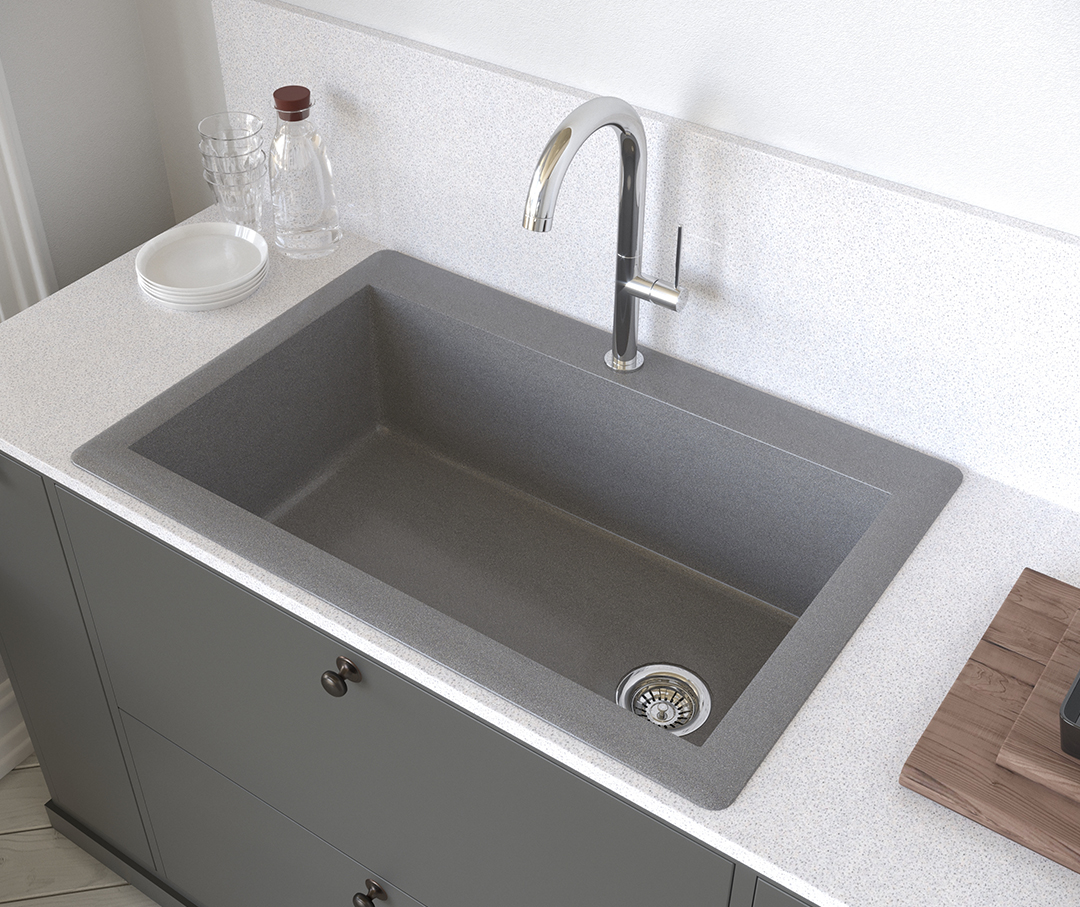
Solid surface is often chosen because it can be fabricated with invisible seams and when used with solid surface sinks, it can be fabricated with a seamless edge that creates a unique integrated look. Only laminates have more color options than solid surface, and solid surface granite-look colors mimic natural granite, at a fraction of their weight and cost. Some solid surface products can withstand exposure to hot pans, and scratches and other stains can usually be buffed out with abrasive cleansers, Scotch-Brite or sandpaper. Impact resistance varies by brand. Check the manufacturer’s specifications. The more acrylic content, the greater the impact resistance.

Butcher block, also known as rock maple, is the choice of gourmet cooks because the wood surface won’t dull knife edges. Full-size counters were popular in the 1970s, but today real butcher block is usually used only in a specific food preparation area such as an island countertop or cutting board space. Butcher block can be damaged by moisture and hot pots and pans. It should be regularly treated with mineral oil to renew its finish. If exposed to raw fish or meat, the wood must be thoroughly washed.

Stone surfaces such as granite, quartz, limestone and, even, concrete are very popular. They usually cost more than other materials, but resist heat and are highly stain resistant, if sealed periodically. Granite is the most requested of these stones, chosen because of its deep rich colors and highly polished luster. Granite is also the hardest and least porous of all stone counters. The drawbacks are visible seams and heavy weight.

An alternative to granite is engineered stone – quartz stone. It has a more uniform look than the natural stone and resists staining and scratching without sealing. Engineered stone is heat-resistant but has poor impact resistance compared with natural granite. Like all stone products, except concrete, engineered stone has visible seams.

Concrete counters don’t look as industrial as they sound. A variety of pigments can be mixed into the material to create an endless array of colors. They need an occasional sealing, but once that’s done, they resist scratches, hot pans and stains – well, like concrete. Choose very strong base cabinets to not only support the extra weight, but to avoid cracks from settling.

Installation

What about installation? Most of these products require professional installation. An experienced do-it-yourselfer might comfortably install a simple, straight-length laminate or stock size solid surface counter, but the installation expertise and savvy required to create custom countertop edges or seams should be left to the pros.

Cost

The most popular materials range from $5 per linear foot for a simple laminate top with stock edge to more than $300 per linear foot for an installed granite counter with a custom fabricated edge.

Solid surface ranges from $70 to $150 a linear foot. Engineered stone (quartz) runs $100 to $150 a linear foot. Ceramic tile has a wide range of about $5 to $75 depending upon style and quality.

Trend

Mixing counter materials is becoming popular. For example: butcher block for a cutting surface, granite or marble for baking preparation and solid surface, laminate or other materials for the rest of the counter space.

For more information, write The Swan Corporation, Department 215, One City Centre, St. Louis, MO 63101, or call (314) 231-8148, or log on to www.Swanstone.com.

###

Swanstone is a leader in the development, manufacturing and marketing of high-quality, solid surface products for the kitchen and bath. The Swanstone brand, known for balancing value and style, is the recognized mark of enduring products. Swanstone, manufactured by The Swan Corporation, is headquartered in St. Louis, Missouri. Swanstone products are sold throughout the world.

© 2006 The Swan Corporation